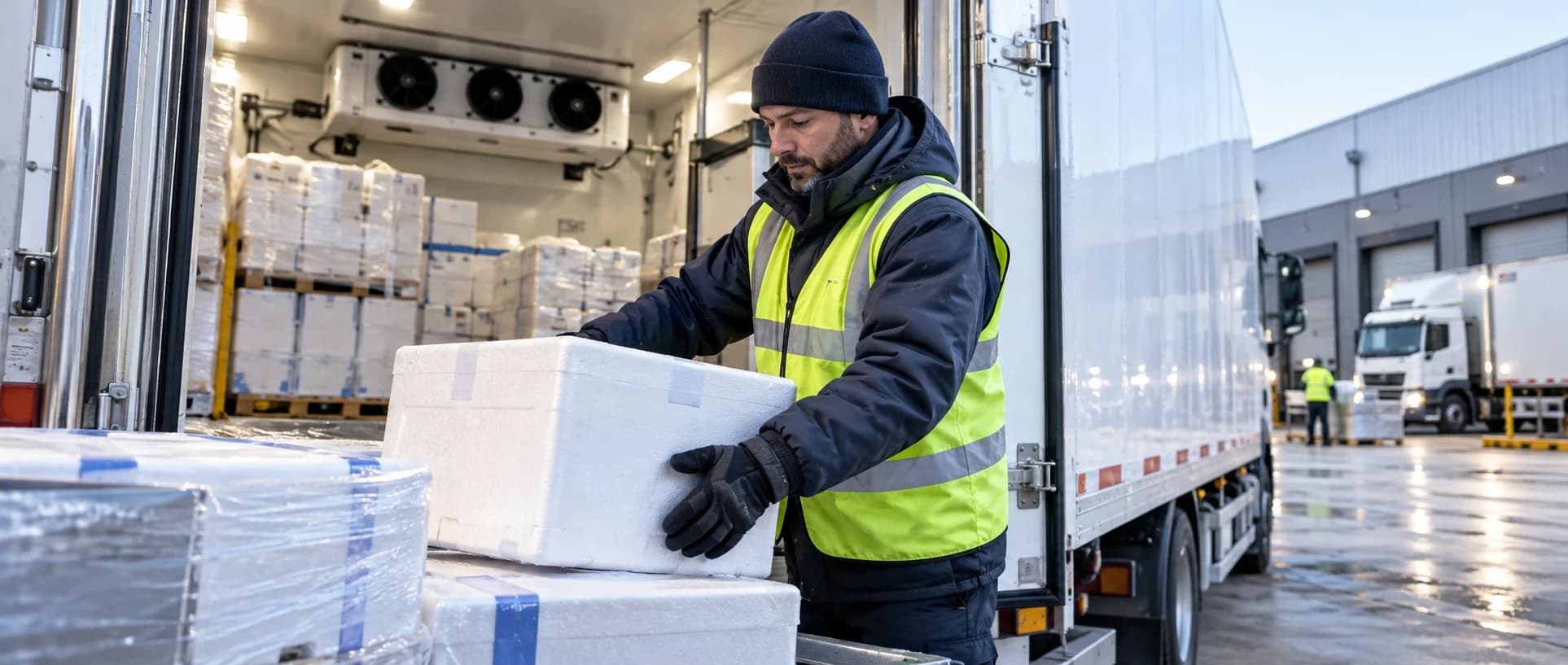
A food bank can receive a shipment of donated meat, eggs, or dairy and still have to turn it away. Not because anything is wrong with the food, but because there is nowhere cold enough to keep it. That is not a food shortage. It is a distribution problem, and the federal government has recently put real money behind it.
What USDA announced
On August 17, 2026, the U.S. Department of Agriculture opened applications for its Cold Chain Grants for Emergency Food Assistance Program. The $7.5 million on offer is meant to help food-assistance organizations buy equipment to store, package, and distribute fresh, frozen, and minimally processed food, according to USDA's announcement. The application window closed on October 1, 2026, so this article is about what the program signals rather than a live opportunity.
The structure is worth noting. USDA is not funding food banks directly. It will select nonprofit organizations that run competitive programs of their own, reviewing applications from local food-assistance groups and funding their cold-storage purchases. Individual subawards can run as high as $200,000, covering equipment, delivery, and installation, with recipients contributing a 10% cash match.
On its own, that reads like a straightforward equipment grant. The context around it is what makes it worth paying attention to.
The gap this is trying to close
Earlier this year, federal agencies announced funding to bring more protein to food banks. An industry estimate cited in that announcement, from the chairman of the nonprofit HATCH for Hunger, put the protein gap in charitable food networks at about 800 million pounds a year, attributing it to infrastructure challenges such as refrigeration and cost. This is a shortfall in the protein food banks can provide, not a count of product that spoiled.
That points to something bigger than one grant. For years, cold chain has been treated as an add-on to food logistics: a refrigerated truck here, a walk-in cooler there. By putting dedicated funding behind it, USDA is effectively treating cold storage as its own piece of infrastructure, not a supporting detail.
Equipment is the easy part
Announcements like this tend to live or die in the execution. A $200,000 subaward can buy a food bank a walk-in freezer. But a freezer that size needs more than four walls and a compressor. It needs a level of operational discipline to run well.
A cold chain is only as strong as its weakest link. One product left out too long, one delayed transport leg, and an otherwise solid storage plan falls apart. More often than not, that weak link is transportation. Storage keeps food cold while it sits still. Transportation keeps it cold while it moves, and moving perishable goods reliably is the harder problem.
It is tempting to picture cold chain logistics as full storage facilities with product ready to ship out. In practice, it comes down to less visible things: routes planned to minimize time in transit, vehicles inspected and confirmed road-ready before they leave, schedules built to avoid delays, and tracking that can confirm a shipment held its temperature the entire way.
More cold storage creates a transportation question
New cold-storage capacity will help, but only partly. Whatever the capacity is, the food has to be brought to it and taken from it. That raises a second question: can the transportation that moves food around absorb the extra load, or does it simply create a different set of constraints?
A bigger freezer increases what an organization can hold, but not how flexible it is. A freezer cannot negotiate a faster pickup, move goods between facilities, or find a place to send a shipment. More storage also means more pickups, delivery windows, vehicle movements and handoffs for the food bank or pantry to manage.
Consider what that looks like on an ordinary day. The freezer has room, but a driver calls in sick. A donor moves up a pickup deadline. A refrigerated vehicle breaks down. A transfer has to be redirected because a facility is full. If transportation capacity does not grow with storage, products wait in storage longer than they should, or leave later than they should, because the organization cannot distribute them quickly enough.
Cold storage still depends on the people moving the food
Every dollar that goes into new cold-storage equipment still has to travel through people to reach the families who need it. Four areas decide whether that works.
Vehicles. Vehicles should be checked before pickup, not after a driver arrives. If one is faulty, the organization needs time to repair it, bring a backup, or change the pickup schedule. Preventive maintenance matters because a delay in a shelf-stable good is far less costly than a delay in a perishable one.
Scheduling. Scheduling has to consider more than available freezer space: driver availability, loading and unloading time, travel time, receiving hours, storage capacity at the destination, time and temperature requirements, and planned outbound distribution. Accepting a donation without being able to schedule a pickup that meets all of these can turn a storage problem into a scheduling problem.
Handoffs. Perishable food may pass from a producer to a consolidation center, a warehouse, a food bank, and then pantries. At each transfer, responsibility for the stock can blur. The process should say who receives the delivery, checks it, takes custody, records temperature data, and responds to deviations.
Exceptions. Monitoring equipment can capture technical data, but the operating process decides who reviews it and what happens next. Cold-chain plans will not always run as scheduled. Vehicles break down, drivers become unavailable, facilities reach capacity, loading takes longer than expected and pickup windows change. The question is not whether exceptions occur. It is whether the operation can identify and respond to them before they become product losses.
A freezer does not move food. Someone still has to schedule the pickup, prepare the vehicle, coordinate the handoff and get the product where it needs to go without breaking the chain.
LMDmax
Keeping vehicles ready and routes covered
A cold chain depends on vehicles that are inspected and ready, and drivers who are available when a pickup is booked. LMDmax Fleet keeps inspections, defect records and preventive-maintenance scheduling together, and Intelligent Scheduler keeps driver availability and backup coverage in one place.
The takeaway
Cold chain deserves to be viewed as more than a logistics function. It is part of the infrastructure that determines whether food can actually move from where it is available to where it is needed. Equipment creates capacity. Operations determine whether that capacity becomes usable.