Fleet management has been through a few of these shifts already. Paper logs gave way to spreadsheets. Spreadsheets gave way to GPS tracking. GPS tracking gave way to full telematics platforms that could tell you not just where a truck was, but how it was being driven.
Each shift made fleets more visible. None of them made fleets easier to run, because more visibility mostly meant more screens to check and more reports to read, not fewer decisions to make.
Industry data backs this up in a fairly blunt way. The American Transportation Research Institute's 2026 benchmarking report puts the industry-average cost of running a truck in 2025 at $2.336 per mile, the highest figure in the report's history, with repair and maintenance costs alone up 8.6% year over year. (ATRI, July 15, 2026)
Costs like that don't come down because a fleet collected more data. They come down because someone actually did something with the data already sitting in the system.
The problem was never a shortage of information
Ask most fleet operators what they'd want more of, and "more dashboards" is never the answer. A telematics platform for vehicle location. A separate tool for fuel cards. Maintenance records in a different system entirely. Payroll and compliance off in their own corner. Every one of these is accurate on its own. None of them tells the whole story by itself.
Scattered, unmanaged data is also a compliance question. When a regulator, auditor or client asks for a record, information that lives in separate systems takes time to assemble, and that is time a fleet usually does not have.
Where AI actually fits
This is where artificial intelligence enters the conversation, and it is worth being precise about what that means in practice, because the term gets used loosely.
Telematics providers describe 2026 as a change of emphasis: from reactive reporting toward predictive, action-oriented use of data, with systems that surface the specific vehicle, driver, or route that needs attention instead of handing a manager a wall of raw numbers to sort through. (See, for example, Work Truck's coverage of Geotab's 2026 predictions.)
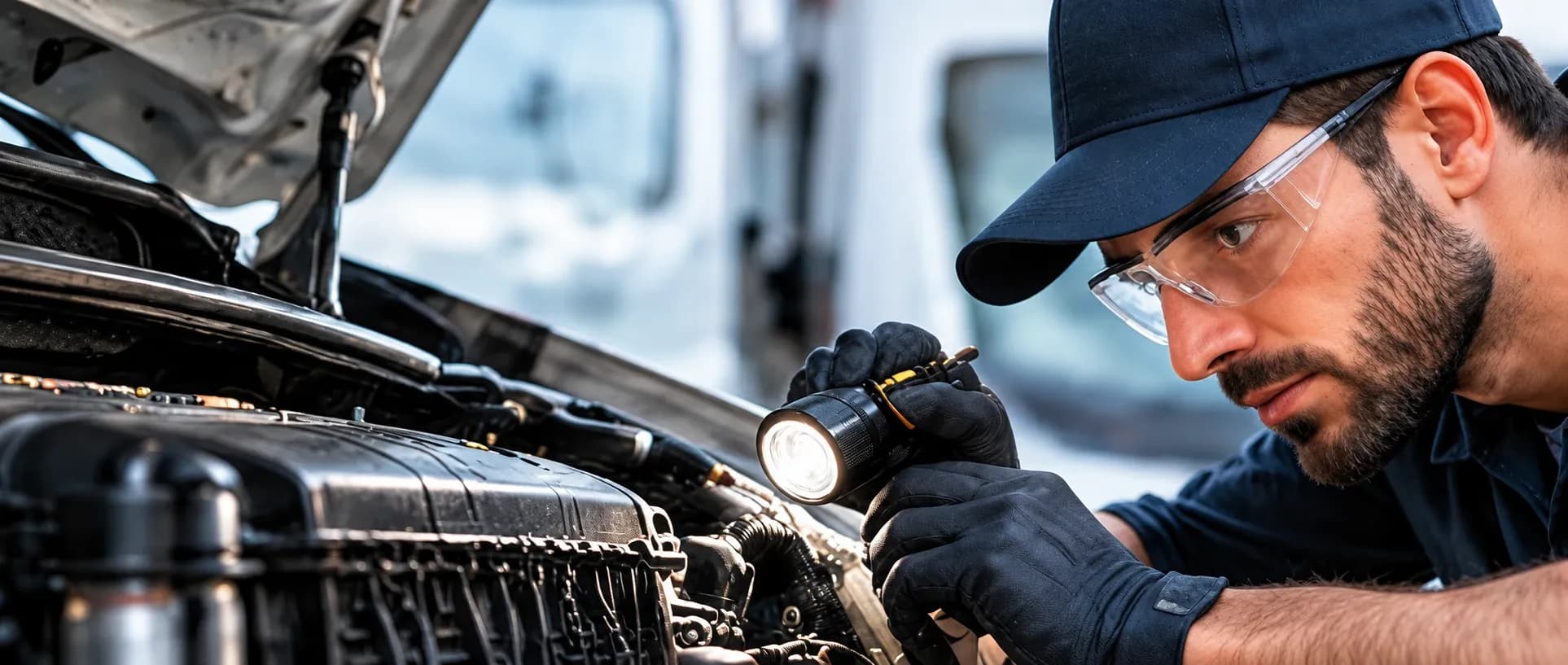
The most commonly cited use case is predictive maintenance: catching small warning signs, such as a rising engine temperature, a shift in fuel efficiency, or a repeated diagnostic code, before they add up to a breakdown. Individually, none of those signals looks urgent. Together, they can indicate a developing problem worth scheduling a fix for on your own timeline, rather than dealing with it on the shoulder of a highway.
That kind of pattern-matching is exactly what software tools tend to be good at, and exactly what is tedious for a person to do by hand across a full fleet, every week. How much it helps depends on the type of fleet, its operating conditions and the quality of its records, so treat any single published benchmark with care.
The part most articles skip: good data comes first
Here is the catch that doesn't get said often enough. None of this works well on bad data.
Incomplete maintenance records, a driver log entered by hand three days late, or two systems that format the same information differently all degrade whatever comes out the other end. A confident-looking recommendation built on shaky, incomplete data is arguably riskier than getting no recommendation at all, because a clean-looking output tends to get trusted more than it has earned.
This is why more fleets are focusing first on fixing their data foundation: reliable records, and systems that actually talk to each other, before layering advanced analytics on top. It's the less exciting half of the story, but it's the half that determines whether the exciting half actually works.
The move toward connected operations
The broader direction here isn't really about AI at all. It's about connection.
A fleet manager shouldn't need to check one system for payroll, another for compliance, another for vehicle operations, and another for administrative tasks just to get a complete picture of how the business is running. Industry trend reports point the same direction for 2026: fleets moving from a stack of separate tools toward one connected system for telematics, compliance, and back-office data. (See Work Truck, Fleet tech in 2026 will stop being a stack and start being a system.)
Connected operations catch problems faster and support better decisions, simply because the information doesn't have to be manually reassembled from five places every time someone needs it.
People are still running the show
None of this replaces an experienced dispatcher's read on customer priorities, a driver's judgment about road conditions, or a manager's sense of which business decision matters this week. What changes is how much of the day gets spent hunting for information instead of acting on it.
The future fleet won't be run by algorithms. It will be run by people who finally have decent tools to work with.
What this means for preparing fleets
The companies that get the most value out of AI over the next few years probably won't be the ones who adopt it first. They'll be the ones who built a solid operational foundation before they needed it: reliable data, connected systems, organized processes, and a clear view into day-to-day operations.
Before any fleet can meaningfully benefit from predictive analytics or automated insights, it has to solve the more basic problem of managing its own information well.
LMDmax
Connecting the data you already have
The article's point is that value comes from connected records, not more dashboards. LMDmax Fleet brings inspections, defect records, work orders and preventive-maintenance scheduling into one place, and Intelligent Scheduler does the same for driver availability, callouts and backup coverage.